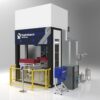
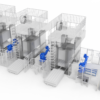
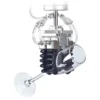


Flame technology prepares plastic parts for painting. Paint does not bond well to polyolefin and polypropylene components, such as car bumpers, because their surface tension is low. Therefore, a flame treatment system passes a controlled gas flame over the part and raises the surface tension. As a result, the paint adheres, and the surface stays clean and reproducible.
Flame Technology: Flame Treatment Systems for Plastic Parts
Technical data
| Power supply | 230 V/50 Hz |
| Control | Siemens S7 PLC |
| Operation | Touch panel, higher-level control |
| Gas supply | 50 bis 1.000 mbar |
|
Gas types
|
Propane/natural gas/city gas |
|
Heat output
|
Up to 50 kW (depending on the type of gas) |
|
Compressed air supply
|
Existing compressed air network, frequency-controlled supply air blower |
Flame Technology

Flame Treatment Technology System
The flame treatment technology system consists of a control unit, which regulates the gas-air mixture and the gasburner. It is divided into two parts, the mechanical part, with all the pipes, valves, pressure switches and mass flow controllers and the electrical part, consisting of the control, visualization, automatic burner control and all the electrical wiring.
In order to achieve optimum paint adhesion on polyfin and polypropylene components, such as bumpers in the automotive industry, a high surface tension must be generated. In addition, a clean reproducible surface is ensured.
Flaming can be effected in two ways:
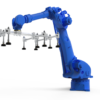
- Flexible by using an industrial robot
- Stationary, with movable parts to be flamed
Flame Technology 2

The advantages
- Flexible burner-design according to customer requirements
- Improved adhesion of the paint on the plastic surfaces
- Reproducibility of the application result
- Improvement of product quality and durability
- Process monitoring in the sense of quality management
- Leakage monitoring of the air/gas mixture hose
- Profibus-, Profinet- or I/O interface
- Integration into higher-level control systems
- Fully automated
- User-friendly interface
- Customized solutions
- Own commissioning personel
- Complete system from a single source
Flame technology FAQ
Which plastics need flame treatment?
Polyolefin and polypropylene components benefit from it, for example automotive bumpers.
Which gases does the flame technology system use?
It runs on propane, natural gas or city gas. The heat output reaches up to 50 kW, although it depends on the type of gas.
Can the system connect to our line control?
Yes. It offers a Profibus, Profinet or I/O interface, so it integrates into higher-level control systems.
How do operators run the system?
Operators use a touch panel. Alternatively, a higher-level control can run it. In both cases, a Siemens S7 PLC controls the process.
Request a flame technology quote
Tell us about your parts, your material and your line speed. Then, our engineers will design the burner and the control unit for your process. We can also supply the paint applicators and the paint supply system for the same line.